
How to Winterise Your Outdoor Cooking Setup
The end of October is the right moment for this, and it is worth doing now rather than in December.


Most outdoor cooking equipment in Britain is used for about four months a year and stored for eight, which is a poor return on something that cost several hundred pounds. The equipment is rarely the reason. Wood-fired ovens, masonry barbecues and fire pits all work perfectly well at four degrees. What stops people is that winter cooking needs a different approach, and nobody tells you what it is.
Cold changes the physics, the timings and the logistics. None of it is difficult once you know what shifts. Here is what actually changes between July and November, and how to work with it.
A fire burns the same at four degrees as at twenty four. What changes is everything around the fire.
Cold masonry, cold cast iron and cold steel all have to be brought up to temperature before they will cook properly, and they are starting from much further back. A refractory firebox that reached a working temperature in twenty five minutes in July may want forty in November. A cast iron grid that was warm to the touch before you started is now at ambient.
The practical consequence is simply to allow more time and more fuel for the warm-up phase, then expect normal behaviour once you are there. The mistake is starting to cook on the same schedule as summer, which puts food onto a surface that has not reached temperature.
Once hot, thermal mass works in your favour in winter. A properly heated refractory chamber holds its heat regardless of the air temperature, which is why masonry and wood-fired ovens are better cold weather appliances than thin-walled metal ones.
If you only take one thing from this: wind matters far more than cold.
Wind strips heat from any exposed surface, pushes smoke sideways into whoever is standing downwind, and makes an open fire behave unpredictably. A still five degree evening is pleasant to cook on. A gusty ten degree one is miserable.
This is where enclosed fireboxes earn their money. A masonry barbecue with a chimney draws air through the fuel bed in a controlled way regardless of what the weather is doing outside it, which is precisely why a Buschbeck Kortina at £399 will cook in November conditions that defeat a kettle barbecue.
If wind is a persistent problem in your garden, a chimney extension at £169.99 raises the flue outlet and improves draw, and it stops smoke being pushed back down toward the cook and the seating.

An enclosed firebox does not care about light rain. The fire is inside, the chimney is above it, and the cooking continues.
What does suffer is everything else: the cook, the food waiting to go on, and anyone standing around. So the winter question is not whether the appliance copes but whether you have somewhere dry to stand and somewhere dry to put things down.
Solve that before you solve anything else. A covered area near the cooking position, even a modest one, transforms how usable a garden is between November and March. Just be careful about what sits directly above a flue: a chimney discharging under a solid roof is both unpleasant and, where it becomes a chimney serving a building, a different set of rules applies.
This is where most winter frustration actually comes from, and it is entirely fixable.
Wood absorbs moisture from damp air even under cover. Wood that burned beautifully in August can be noticeably harder to light in November if it has been sitting in an open store through autumn rain. Damp fuel produces smoke rather than heat, which is the classic winter complaint.
Store it properly: off the ground, covered above, open at the sides for airflow. Sealed under plastic is worse than uncovered, because it traps moisture. Bring the next session’s wood into somewhere genuinely dry a day or two ahead. That one habit fixes most winter lighting problems.
Charcoal has the same issue in a quieter way. Damp charcoal lights reluctantly and burns cool. Keep it indoors or in a sealed container rather than in a shed that breathes.
Allow more fuel overall. You are heating cold mass and losing more to the air, so a winter cook simply consumes more than the same cook in summer.
There is no point pretending that lighting a fire and managing it for forty five minutes is an attractive proposition at six o’clock on a wet Wednesday in November.
Gas removes the entire problem. Ten minutes to temperature, no fire management, no ash. If you have a masonry barbecue, the Stainless Steel Gas Burner Insert at £389 converts the firebox, and it is the single change most likely to turn a summer appliance into a year-round one.
For pizza, the dual fuel ovens do the same job. A Fontana Margherita Countertop Dual Fuel at £2,349 runs on gas when you want dinner and wood when you want the occasion.
One winter gas note: cylinders lose pressure in cold weather, and a cylinder that seemed fine in September can struggle at near freezing. Keep it somewhere sheltered, and if performance drops off in very cold conditions that is usually the cause rather than a fault.
Winter suits different food, and leaning into that is more satisfying than trying to recreate July.
Long, slow cooking comes into its own. A firebox that holds heat will happily do a pork shoulder or a brisket over several hours, and standing outside tending it is far more appealing in November than in August heat. The cook gets the warmest spot in the garden.
Anything that arrives hot and stays hot works better than delicate food that cools on the walk to the table. Stews and braises in a cast iron pan, roasted roots, whole joints, flatbreads straight from a hot stone.
Pizza is genuinely better in winter. Standing next to a 400 degree oven is a pleasure in the cold, the contrast is part of the appeal, and a Universal Artisan Pizza Oven Insert at £159.99 gets you there through an existing masonry firebox.
Where a solid surface helps most is with the small, quick items that would otherwise cool instantly. A Cast Iron Plancha at £99.99 holds heat well enough to keep working in cold air, which thin steel does not.
None of the cooking matters if everyone retreats indoors.
A cooking appliance does not warm a group. A masonry barbecue sends its heat up the flue and into the food, which is what you want from it, and means it contributes almost nothing to how comfortable your guests are.
That is the case for having a fire bowl as well as a barbecue. A Buschbeck Ifen 80cm at £159.99 radiates outward at seated height and gives people a reason and a place to stay outside once the food is done. Our comparison of the two covers why they are complementary rather than alternatives.
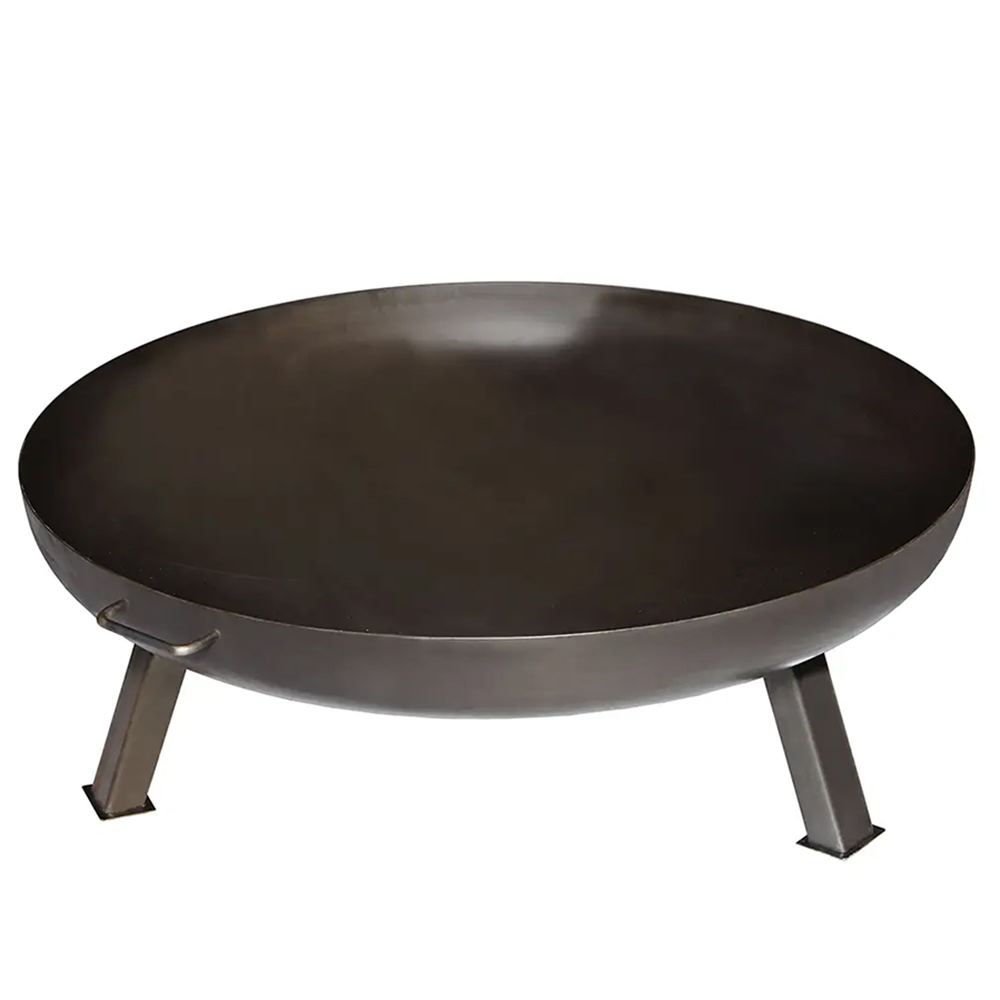
Light the space properly as well. Winter cooking happens in the dark, and a garden you know in daylight is unfamiliar at five o’clock in November.
Winter use and winter care are not in conflict, they just need a rhythm.
Empty ash after each use rather than seasonally. Wet ash sitting against steel or refractory over winter is what causes damage, and a stainless steel fire grate and ash pan at £99.99 makes that quick enough that it actually happens.
Cover between uses, and cover a dry unit rather than a wet one. A Masonry Barbecue Full Cover at £99.99 keeps water out of the refractory, which is the thing frost damages.
Bring cooking surfaces and accessories in after each session rather than leaving them out all winter. Our guide to winterising an outdoor cooking setup covers the full list.
The full range of covers and accessories is in our Buschbeck collection, and we are on 02476 474440 if you want advice on making a particular setup workable through winter.
The end of October is the right moment for this, and it is worth doing now rather than in December.

Bonfire Night falls on Thursday 5 November this year, which means most people will actually mark it on the weekend