
Bonfire Night in Your Garden: A Host’s Guide
Bonfire Night falls on Thursday 5 November this year, which means most people will actually mark it on the weekend


The end of October is the right moment for this, and it is worth doing now rather than in December. Not because the cooking season is over, plenty of people use a masonry barbecue or a fire pit through winter, but because everything is still accessible, the weather is still tolerable, and the first hard frost has not arrived yet.
Almost all winter damage to outdoor cooking equipment comes down to one mechanism: water gets into something, then freezes and expands. Ninety percent of winterising is therefore about keeping water out of the places it does harm. Here is what that actually means for each type of setup.
Cold on its own does nothing. Steel, cast iron and refractory concrete are all perfectly happy at minus five.
What causes damage is water that has soaked into a porous material, then frozen. Water expands by roughly nine percent as it turns to ice, and if that happens inside a refractory panel or a hairline crack in concrete, the material loses. Repeated freeze and thaw cycles, which is exactly what a British winter delivers, do it progressively.
So a small crack noticed in October is a repair. The same crack ignored until February is often a replacement panel.
This is where money is genuinely at stake, because these units stay outdoors permanently and the refractory lining is the vulnerable part.
Start by getting it properly clean. Remove all the ash, and mean all of it: ash is alkaline and holds moisture against the surfaces it sits on, which is a bad combination over three months. Take out the grills, clean them, and store them somewhere dry rather than leaving them in place to rust.
Then inspect the refractory panels and the firebox properly, in daylight, before covering anything. Look for hairline cracks, flaking, and any movement at the mortar joints. Small cracks are normal in refractory and not usually a problem, but anything you can get a fingernail into is worth addressing now. Replacement parts are available individually, so a replacement left side refractor at £44.99 or an inner refractory concrete hood at £169.99 means a repair rather than a new barbecue. A bag of Buschbeck Grey Mortar at £19.99 handles joint repointing.

Then cover it. A Buschbeck Masonry Barbecue Full Cover at £99.99 is the single best value item in this entire article, because it prevents the failure mode that costs hundreds. For the grill bar models there is a Venedig Grill Bar and Luzern cover at £89.99.
One important detail on covering: the unit needs to be dry before the cover goes on, and the cover needs to breathe. Sealing a damp barbecue under a waterproof sheet traps the moisture exactly where you do not want it, which is worse than leaving it uncovered. Cover a dry unit on a dry day.
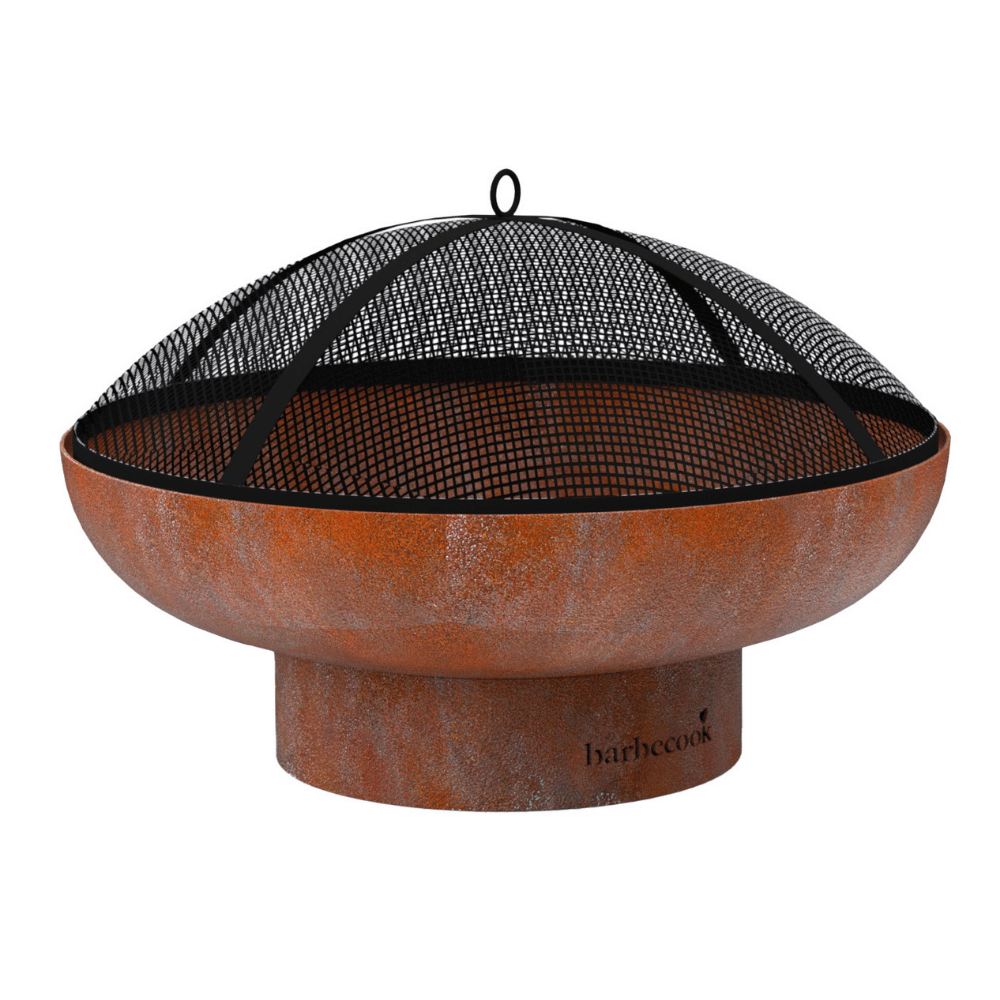
A fire bowl full of wet ash over winter is a bowl of corrosive slurry sitting against steel for months. That is what shortens the life of a fire pit, not the cold.
Empty it completely. Check that any drainage holes are clear, because a blocked drain turns the bowl into a water tank. If the pit has a base or stand, check underneath too, since that is where water tends to sit unnoticed.
Weathering steel needs a specific mention. Corten is designed to get wet and dry out, and that cycling is what keeps the patina stable. What it genuinely dislikes is standing water. So a Corten bowl is fine left out in the rain and not fine left holding several inches of it. Empty it, keep the drains clear, and do not seal, oil or wax it.
Cooking accessories should come indoors. A plancha ring or a cooking grill left in place all winter will be in noticeably worse condition by March. Clean them, dry them, and oil cast iron lightly before storing.
If you plan to keep using the pit through winter, which is when it earns its keep, then just empty the ash regularly rather than seasonally. A stainless steel fire grate and ash pan at £99.99 makes that a thirty second job, which is the difference between it getting done and not.

Wood-fired ovens live outdoors year round without difficulty, and many are better used in winter than summer. The requirement is simply that the chamber stays dry.
Clear the ash out. Make sure the door seals properly, or that the opening is covered if it does not. Water getting into a refractory chamber and freezing is the one thing that damages these ovens, and it is entirely preventable with a cover.
If the oven is on a trolley, check the wheels and the frame for rust and treat anything starting. Trolley frames tend to be the first thing to go on an otherwise sound oven.
For built-in ovens, check the flue is clear and that the enclosure is draining properly away from the oven body. Water pooling inside an enclosure is a problem you will not see until it has done damage.
If you run a gas burner insert or a gas barbecue, there are a few specifics.
Disconnect the cylinder and store it upright, outdoors or in a ventilated space, never in a sealed shed, cellar or indoors. Check the hose for perishing, cracking or hardening, and replace it if there is any doubt, because hoses degrade with UV and age rather than use.
Clean the burners properly. Grease left over winter goes hard and blocks ports, and a partially blocked burner in spring means uneven heat and a frustrating first cook of the year.
This is the practical tip that saves the most annoyance. If the inspection turns up a worn grill, a cracked panel, a perished hose or a missing part, order it now.
Spring is when everyone else discovers the same thing, and demand for barbecue spares spikes in the first warm week of the year. A part ordered in October arrives in days. The same part in April can take considerably longer.
Replacement cooking surfaces are worth a thought while you are at it. A cast iron cooking grid at £89.99 holds heat far better than chrome and marks food properly, and the chrome cooking grill at £39.99 is the economical straight replacement.

Stays out happily: masonry barbecues, fire bowls, built-in and trolley pizza ovens. These are designed for it.
Comes in: cooking grills and grids, planchas, thermometers, tools, gloves, pizza stones, and anything with a fabric or timber component. Pizza stones in particular should never be left to absorb water and then freeze.
Stays out but disconnected: gas cylinders, upright and ventilated.
Ash out of everything. Grills and accessories cleaned, dried and stored inside. Refractory and firebox inspected in daylight. Drainage holes clear. Gas disconnected, hose checked, burners cleaned. Spares ordered. Covers on, over a dry unit, on a dry day.
That is an hour or two of work in late October that determines what condition everything is in next April. Covers and spares are in our Buschbeck spares and replacement parts range, and if you are not sure which cover or part fits your model, call us on 02476 474440 with the model name and we will match it.
Bonfire Night falls on Thursday 5 November this year, which means most people will actually mark it on the weekend
Fire pit accidents are almost never dramatic. They are scorched decking, a melted section of artificial grass, a fence panel